The Eye Never Lies: Revolutionary Do's and Don'ts for Visual Destination Marketing
Relevant topics Archive, Strategy
Imagine this: You’re scrolling through travel photos online. A bright coastal landscape catches your eye. You pause for a moment, zoom in, and look again. But when it’s time to choose your next trip, you pick somewhere else entirely. This small contradiction happens more often than marketers think.
A recent neuromarketing eye-tracking study from Rùben Pinhal and colleagues explored how people visually engage with destination images.
Participants recruited from the University of Beira Interior community (Covilhã, Portugal) were shown photos of Portuguese UNESCO Creative Cities while their eye movements were recorded. Afterwards, they were asked which images they preferred.
The result was a fascinating insight for destination marketing: the images that attract the most visual attention are not always the ones people consciously prefer. For marketers, that means one thing: what tourists look at and what they say they like are not always the same.
Understanding this gap can help destinations design visual content that performs better in the crucial first moments of attention.
Case Study: What the Portugal Cities Study Reveals
Focusing on Portuguese cities designated as part of the UNESCO Creative Cities Network - a network of cities that integrate creativity into their cultural and economic identity - makes this study particularly interesting, as it focuses on cultural imagery and helps explain why certain visual elements attract attention and influence destination choice.
Participants were shown three representative photographs per city, covering Amarante, Barcelos, Braga, Caldas da Rainha, Castelo Branco, Covilhã, Santa Maria da Feira, Idanha-a-Nova, Leiria, and Óbidos. The researchers used eye-tracking technology to measure three key behaviors: where people looked first (saccades), where they lingered longest (fixations), and what drew them back for another glance (revisits). They compared this unconscious visual behavior with explicit preference choices.
Take Barcelos, famous for its colorful rooster symbol. Image B2, featuring the iconic Galo de Barcelos, dominated visual attention metrics: longest viewing times, most fixations and highest revisit rates. The cultural symbol acted like a visual magnet, pulling eyes back repeatedly. Yet when participants made conscious choices, they favored B1, a more conventional architectural shot.
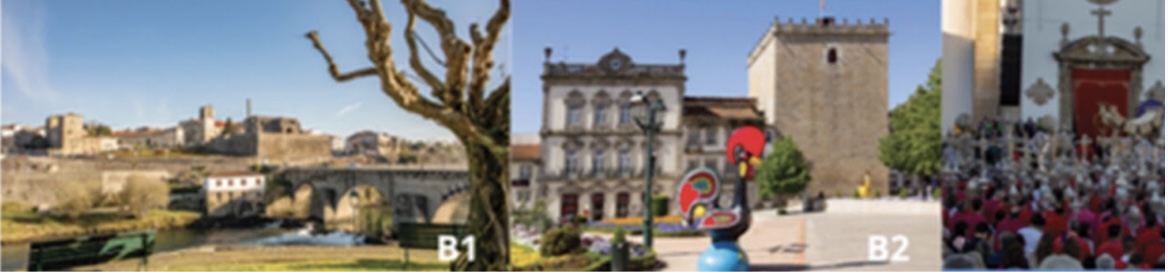
Images used in the study (Barcelos)
Cultural symbols can strongly attract attention, but they do not always drive preference. They act as visual magnets, but their meaning can trigger mixed reactions depending on the viewer’s cultural interpretation.
Covilhã revealed even more complexity. Image C2 captured the longest total viewing time, image C3 generated the most fixations and revisits, but image C1 won the popularity contest. Three different images dominated three different metrics.

Images used in the study (Covilha)
In other words, attention, and preference followed different patterns. For marketers, this reinforces the importance of evaluating visual content from multiple perspectives, not just what people say they like.
What Actually Captures Tourist Attention?
Across the study, participants frequently mentioned several visual elements when explaining their choices.
The most mentioned factors were: colour, landscape and natural scenery, architecture, human presence, and familiarity. Cultural symbols attract a lot of attention, but also trigger complex cognitive-emotional responses that can either enhance or undermine conscious preference.
These elements consistently helped images stand out visually. Importantly, the most successful images often combined multiple elements, for example, historic architecture within a natural landscape. This combination seemed to balance visual attraction, and conscious appreciation.
Your Visual Marketing Toolkit: Evidence-Based Do's and Don'ts
Based on the study’s findings, several practical guidelines emerge for destination marketers.
DO's:
- Prioritize vibrant, nature-centric visuals. For example water, greenery, gardens and bright, and contrasting colors. These elements enhance visual engagement for destinations.
- Think of visual storytelling by adding architecture and human elements in your image.
- Use culturally embedded symbols strategically. They create unconscious engagement, but prepare for mixed conscious reactions.
- Familiarity draws the eye, using recognizable places and human moments to make your image instantly relatable.
- Combine the elements above to take your advertisement to the next level!
DON'Ts:
- Don't rely solely on stated preferences. The Barcelos example proves conscious choice doesn't predict visual engagement.
- Don't assume attention equals approval. Cultural symbols can trigger prolonged viewing while generating conscious resistance.
Your Action Plan (Take Home Message):
First, capture attention: with high contrast color, landscape, architecture, and people. Make sure to add visually appealing elements.
Secondly, build meaning: with cultural identity and authenticity, but be aware that their meaning can trigger mixed reactions depending on the viewer’s cultural interpretation. Ideally, you test this beforehand.
Lastly, measure both layers: conscious (surveys) and unconscious (eye-tracking), to understand what consumers prefer.
In conclusion, the eye never lies, but it doesn't tell the whole truth either. Smart destination marketers use eye-tracking data alongside traditional methods to create visual strategies that capture both conscious choice and unconscious desire.

Rúben Pinhal, Estima, A., & Duarte, P. (2025). See, like, and book: Eye-tracking the power of visual attention in destination marketing. Journal of Marketing Communications, 1–21. https://doi.org/10.1080/13527266.2025.2511144